
Showing posts with label United States. Show all posts
Showing posts with label United States. Show all posts
Wednesday, February 22, 2012
LSD & Uterine Contractions

Tuesday, January 31, 2012
Furthur: Best Posts of 2011
Here's a quick recap of this year's top ten posts you shouldn't have missed:
 Tripping For The First Time
How To Avoid Bad Trips
Synesthesia: Part 2 (My Experience)
Trying DMT Part 2
Why Pot Supporters Shouldn't Use the Term "Marijuana"
Saying No: How and Why
Portugal's Drug Decriminalization: 10 Years Later
The Windows of the Skull
Time Flies... Or Jumps, or Skips, Or...
An Issue of Liberty


How To Avoid Bad Trips
Synesthesia: Part 2 (My Experience)
Trying DMT Part 2
Why Pot Supporters Shouldn't Use the Term "Marijuana"
Saying No: How and Why
Portugal's Drug Decriminalization: 10 Years Later
The Windows of the Skull
Time Flies... Or Jumps, or Skips, Or...
An Issue of Liberty
Thursday, June 23, 2011
Portugal's Drug Decriminalization: 10 Years Later
We spend so much time arguing about whether a society where drugs were legal would be one of peaceful joy or hedonistic anarchy. Everybody has an opinion, but the facts are often ignored. Very few people know that ten years ago, Portugal decriminalized all drugs. Now that a decade has passed, the results can be analyzed-- and they're very promising.
THE POLICY
Decriminalization is different from legalization-- those caught with more than ten days' personal worth of drugs still have to face penalties. However, these penalties are administrative rather than criminal. This was a choice made by the Portugese government as a result of their drug problem: instead of incarcerating casual users, they gave them the option to seek help for addictions. This makes it a healthcare issue, rather than a criminal one, and eliminates the stigma. The accused are brought before a discussion board that consists of a legal official, a counselor, and a healthcare official. The board will recommend either treatment, a fine, a warning, or no penalty. Other penalties include the revocation of career licenses, a ban on visiting high-risk areas like nightclubs, or a restriction on international travel. Dealers and traffickers still get the same penalties as they did before the law was passed.
THE RESULTS


Overall, drug use in Portugal has increased slightly among most age groups, but drug-related problems have decreased sharply. The number of deaths from overdoses has dropped from an average of 400 to an average of 290, and HIV cases from dirty needles plummeted from 1,400 to just 400. Probably most encouragingly, the numbers of people seeking treatment for drug addiction more than doubled. In fact, more Americans have used cocaine than Portugese have used cannabis: only 10% of Portugal's population uses it over the course of their lives (and I guess that's some sort of good thing). There have been some moves to improve the policy's efficiency through bureaucratic changes, but very few people are trying to repeal it. Much of the rest of the EU is looking to follow in Portugal's footsteps. It looks like good news to me!
IN CONCLUSION
Many international treaties make a ban on drugs an obligation, so decriminalization is the most realistic option and seems to have worked really well. America's legalization proponents should look into this as a compromise. It keeps everybody happy: politicians get to feel effective, users don't get hunted like witches and burned at the stake, and those who really need help with their drug use can get the help they need without fear of incarceration.
SOURCES

Tuesday, June 14, 2011
The Emperor Wears No Clothes
The legalization of hemp is generally viewed as a human rights issue, a constitutional issue, or a crime issue. Jack Herer presents it as an economic and environmental issue as well, in his history of hemp usage The Emperor Wears No Clothes. In it, he implores us to be like the innocent little boy from the fairy tale and expose the lies that the Drug War is built upon. In addition to supporting what I said here, he gives us lots of fun facts like:


- The word "Cannabis" has its roots in the world's first languages.
- The widespread use of hemp would solve many problems: it's more renewable than trees for paper, it lessens the need for petrochemicals as fuel, and it would provide jobs and preserve family farms.
- Before it was banned, cannabis was listed in marriage guides as an aphrodisiac.
- Ganja as a force for peace began as anti-communist propaganda. At first, weed was banned because of the supposed violence and disobedience it incited in racial minorities, but during the Red Scare it was treated as a communist plot to make us all indolent.
- Hemp seeds are one of the single most nutritious foods on the planet, and could be used like soy is now. Gruel is traditionally made from mashed-up hemp seeds.
- Chillums have their origin with Hindu priests.
- The fact that we have chemical receptors to which THC binds evidences an ancient symbiosis with this plant that humans have been using for 10,000 years.
- Temperance organizations, during the prohibition movement, recommended hashish as a substitute for the evil alcohol.
- Army tests administered over a span of two years show that soldiers who regularly smoke pot do not lose any performance or motivation.

Monday, May 23, 2011
Why Pot Supporters Shouldn't Use The Term "Marijuana"
This is a belief I've held for a while, although obviously I often slip and use the more common term. Unfortunately, I can't remember what I read that first provided me with this information, so I had to re-research everything to make sure my facts are straight. Most of it was gleaned from this article.
Hemp was the major staple of George Washington's garden. Hemp was sold in American pharmacies. Hemp was required to be grown by colonial farmers. So why, now that it's illegal, is it referred to as marijuana? The term marijuana has a short history in America, filled with racism and political intrigue.
Although the middle east has a history of hashish use, hemp wasn't really smoked recreationally in America until Mexican immigrants brought the practice with them into the western states around the 1930s. California was the first to ban the "preparation" of hemp, after Mexicans were observed doing it, and many western states followed. This was happening right at the time of the prohibition of alcohol, and the government was testing how far it could go banning mind-altering substances. Apparently, it found that it could go quite far.
In the east, the racism was directed at the black Jazz musicians. Their weed-smoking habits formed a central part of their musical sub-culture. Since they were seen as immoral and dangerous, this terrified the populace. Henry Anslinger, the rightly-reviled crusader against weed and the head of the Federal Bureau of Narcotics, is alleged to have made many racist statements, including “…the primary reason to outlaw marijuana is its effect on the degenerate races" and “Reefer makes darkies think they’re as good as white men.” No matter what the time period, these are not appropriate statements for a public figure to make.
Rumors began circulating linking marijuana use to murder and violent behavior, but it was obviously unfounded speculation based on the fear of other races. For example, newspaper tycoon William Randoph Hearst writes, "“Was it marijuana, the new Mexican drug, that nerved the murderous arm of Clara Phillips when she hammered out her victim’s life in Los Angeles?… THREE-FOURTHS OF THE CRIMES of violence in this country today are committed by DOPE SLAVES — that is a matter of cold record.” It's important to note that Hearst had much to gain, since the sensationalism sold newspapers and the use of wood-based paper over hemp-based assured him profits from his investments.
As soon as hemp was in non-white hands, it was labeled with the exotic term "marijuana," which the layman did not know was the same plant. William C. Woodward, of the American Medical Association, cited this as a reason to reject the bill proposing its prohibition. In the article I linked to above, the author writes,
Though the term marijuana has lost its racist connotations for the most part, its history is largely ignored. It's important for weed smokers (just like anybody) to realize the implications of the terms that they use, and choose one that fits what they mean. In my opinion, "hemp" is the best term because of its historical use and its harmless connotations, but "weed" and "pot," though vague, are a little less formal and work just as well.

Hemp was the major staple of George Washington's garden. Hemp was sold in American pharmacies. Hemp was required to be grown by colonial farmers. So why, now that it's illegal, is it referred to as marijuana? The term marijuana has a short history in America, filled with racism and political intrigue.
Although the middle east has a history of hashish use, hemp wasn't really smoked recreationally in America until Mexican immigrants brought the practice with them into the western states around the 1930s. California was the first to ban the "preparation" of hemp, after Mexicans were observed doing it, and many western states followed. This was happening right at the time of the prohibition of alcohol, and the government was testing how far it could go banning mind-altering substances. Apparently, it found that it could go quite far.
 |
| Not okay. |
Rumors began circulating linking marijuana use to murder and violent behavior, but it was obviously unfounded speculation based on the fear of other races. For example, newspaper tycoon William Randoph Hearst writes, "“Was it marijuana, the new Mexican drug, that nerved the murderous arm of Clara Phillips when she hammered out her victim’s life in Los Angeles?… THREE-FOURTHS OF THE CRIMES of violence in this country today are committed by DOPE SLAVES — that is a matter of cold record.” It's important to note that Hearst had much to gain, since the sensationalism sold newspapers and the use of wood-based paper over hemp-based assured him profits from his investments.
As soon as hemp was in non-white hands, it was labeled with the exotic term "marijuana," which the layman did not know was the same plant. William C. Woodward, of the American Medical Association, cited this as a reason to reject the bill proposing its prohibition. In the article I linked to above, the author writes,
"At this point, marijuana (or marihuana) was a sensationalist word used to refer to Mexicans smoking a drug and had not been connected in most people’s minds to the existing cannabis/hemp plant. Thus, many who had legitimate reasons to oppose the bill weren’t even aware of it."Unfortunately, he was ignored and the bill was passed.
Though the term marijuana has lost its racist connotations for the most part, its history is largely ignored. It's important for weed smokers (just like anybody) to realize the implications of the terms that they use, and choose one that fits what they mean. In my opinion, "hemp" is the best term because of its historical use and its harmless connotations, but "weed" and "pot," though vague, are a little less formal and work just as well.
Wednesday, May 18, 2011
"Hello, my name is not Sunshine."
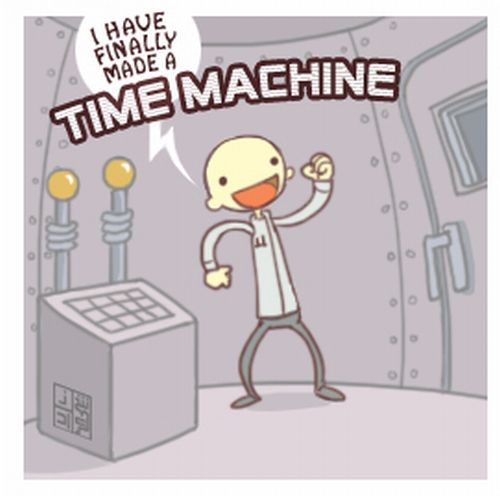
Yesterday, I got into an argument with a friend. I've always respected her for her intelligence, her analytical ability, her spunk, and her awesome 'fro. The way she is always challenging the ideas that she and the people around her hold close to their hearts is a trait of which I am deeply envious, but I can't pretend it doesn't create friction from time to time. She has recently become even more interested in black activism, and has been giving presentations about hair & black identity, and other interesting stuff like that. In a show of support, I playfully suggested that we find a time machine and go back to the sixties, so she could experience the Civil Rights movement and then we could swing by Woodstock for me.
That really pissed her off, for reasons that she then decided to detail.

She noted that I would have been treated much better than she would have, which is why the Civil Rights movement needed to happen in the first place. The heroes of that time period did what they did so that in the next millennium she could live fear-free, as she does. Respectable & more than valid; I agree entirely.
Another of her reasons, though, was that she feels that anyone who wishes to live in a different time period suffers from an “overly patriotic, white washed” and “limited” perspective gleaned from Euro-centric textbook representations. This is where I felt the need to disagree and express what it is about the sixties that draws me like it does. It's not what you might expect.
I am more than willing to admit that I am an idealist, and not just when it comes to the past. Part of what I do idolize about the sixties is the fashion, the drugs, the youth culture. I like to imagine that there were more people then who would understand me. I often wish for warm-bodied spontaneity, which in my imagination existed in a much higher quantity before the Internet became a household time-sucker. I wish more people around me understood the spiritual and philosophical nature of my drug use, instead of judging me as somebody who's just looking for kicks. I crave a community of care-free youth like me, which I imagine existed in abundance in the 1960s. I know that it's unrealistic, but that's why it's a dream.
But I'm not stupid. I know that the sixties wasn't groovy all around: not everybody upped 'n' changed their name to sunshine. Some serious stuff was happening, some good and some bad. The Civil Rights movement, the Vietnam draft, the moon landing. The government was redefining its relationship with the American people. We were literally rocketing into the future. In a vital way, the culture of the hippies was a reaction to these things, which has not been lost on me. The commitment of the youth to wildness, rebellion, and fun was an almost hysterical retaliation to the inescapable fear of nuclear destruction. In a way, what I long for are those times that are less complacent, less sure. This was a pivotal time in America for a variety of reasons, all of which interest me. Not to mention Star Trek. :)
However, I agree with my friend on one important point: as long as I'm here at the beginning of the new millennium, there's still quite a bit of stuff for activists like me and my friend to do. Now interracial couples can get married, but homosexuals can't. Blacks and women, though we can vote & hold down jobs, still have social attitudes to correct and understanding to create. I know I belong in this time and that I've got work to do, but that doesn't mean that I keep my bell-bottoms and my freak flag in my drawer, no?
The thing the sixties did was to show us the possibilities and the responsibility that we all had. It wasn't the answer. It just gave us a glimpse of the possibility.
-John Lennon
Friday, April 15, 2011
Trying DMT Part 1
My friend asked me recently whether it was a good idea to make DMT his first psychedelic. I haven't done DMT, but my first reaction was "Of course not!" However, when he explained his reasoning, I warmed up to it a little: if he doesn't like it, it's over quickly. He's done his research and feels prepared, even if a little anxious, whereas the thought of doing LSD or shrooms makes him nervous. This seems like good reasoning to me, so I decided to do a little research to decide whether or not to join him.
DMT is a chemical that is found naturally in various plants and mammals, including rats' brains, and human cerebrospinal fluid. It has been hypothesized, but not proven, that it is released by the pineal gland during dreams, near-death experiences, religious epiphanies, and in massive amounts just before death. Its structure is very similar to serotonin, which is a neurotransmitter responsible for causing feelings of pleasure and serenity in the brain. It has a long history of use among the indigenous tribes of South America.
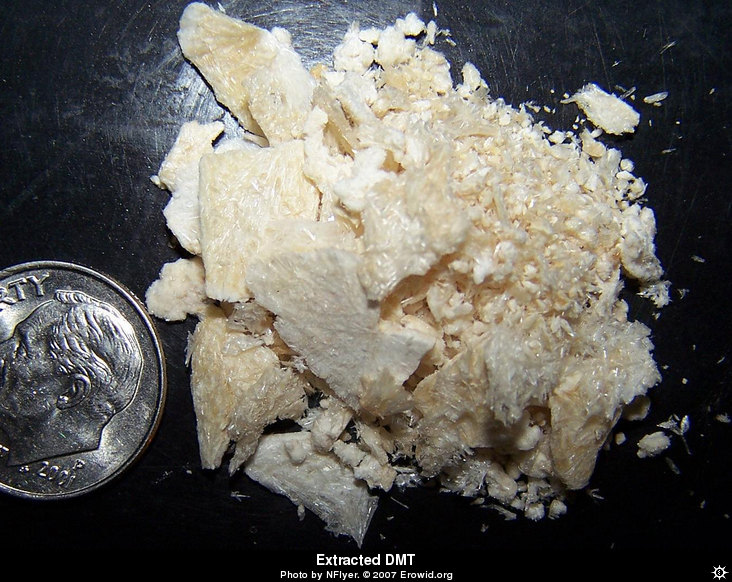
Pure DMT is apparently a crystalline substance that can be smoked, snorted, injected or even (when combined with an MAOI) drank in a brew called Ayahuasca. As per most hallucinogens, it is generally considered nonaddictive. Unlike LSD and shrooms, it can produces true hallucinations (I'll post about the difference later) and open-eye visuals, often of a spiritual nature. Many users report interacting with aliens, elves, and other fantastical creatures.

An average dose is commonly priced at $10-30. Its effects begin almost immediately, within 10-60 seconds of inhalation. Apparently it smells and tastes atrocious, like burning plastic, and the smoke is very harsh, but it should be breathed in deeply. It is recommended to have someone near you to take the pipe from you so you can lay down immediately; otherwise you risk a loss of motor control that can cause you to collapse. The entire experience lasts only 5-20 minutes, although full sobriety may not return for up to a few days, especially after a bad trip. After your trip, make sure you've lost your shakiness before you attempt to stand up. It's not a party drug, so don't mix it with other recreational substances, at the risk of either dulling the experience or becoming overwhelmed.
DMT is known to elevate blood pressure, so don't try it if you know that's a problem for you. The trip is made stronger by combining it with MAOI's, but this may not be a good idea. MAOI's are a group of chemicals commonly used as anti-depressants, and are also found in substances like tea, olive oil, cigarettes, pepper, and coffee. MAOI's can be addictive and cause numerous unpleasant drug interactions that may result in psychosis or death, so be extremely careful and do your research if this is on your to-do list. Other than these, there are no negative health effects of DMT.
To me, the totally immersive nature of the experience seems scary and overwhelming, but this is a chance that I can't pass up. It is made a little less intimidating by the fact that I will have friends present that have done it before. I'll let you know in a later post how it goes for my friend and I!
SOURCES:
Erowid
Wikipedia
Lycaeum

DMT is a chemical that is found naturally in various plants and mammals, including rats' brains, and human cerebrospinal fluid. It has been hypothesized, but not proven, that it is released by the pineal gland during dreams, near-death experiences, religious epiphanies, and in massive amounts just before death. Its structure is very similar to serotonin, which is a neurotransmitter responsible for causing feelings of pleasure and serenity in the brain. It has a long history of use among the indigenous tribes of South America.
Pure DMT is apparently a crystalline substance that can be smoked, snorted, injected or even (when combined with an MAOI) drank in a brew called Ayahuasca. As per most hallucinogens, it is generally considered nonaddictive. Unlike LSD and shrooms, it can produces true hallucinations (I'll post about the difference later) and open-eye visuals, often of a spiritual nature. Many users report interacting with aliens, elves, and other fantastical creatures.
An average dose is commonly priced at $10-30. Its effects begin almost immediately, within 10-60 seconds of inhalation. Apparently it smells and tastes atrocious, like burning plastic, and the smoke is very harsh, but it should be breathed in deeply. It is recommended to have someone near you to take the pipe from you so you can lay down immediately; otherwise you risk a loss of motor control that can cause you to collapse. The entire experience lasts only 5-20 minutes, although full sobriety may not return for up to a few days, especially after a bad trip. After your trip, make sure you've lost your shakiness before you attempt to stand up. It's not a party drug, so don't mix it with other recreational substances, at the risk of either dulling the experience or becoming overwhelmed.
DMT is known to elevate blood pressure, so don't try it if you know that's a problem for you. The trip is made stronger by combining it with MAOI's, but this may not be a good idea. MAOI's are a group of chemicals commonly used as anti-depressants, and are also found in substances like tea, olive oil, cigarettes, pepper, and coffee. MAOI's can be addictive and cause numerous unpleasant drug interactions that may result in psychosis or death, so be extremely careful and do your research if this is on your to-do list. Other than these, there are no negative health effects of DMT.
To me, the totally immersive nature of the experience seems scary and overwhelming, but this is a chance that I can't pass up. It is made a little less intimidating by the fact that I will have friends present that have done it before. I'll let you know in a later post how it goes for my friend and I!
SOURCES:
Erowid
Wikipedia
Lycaeum
Subscribe to:
Posts (Atom)